




 319 / 948

WHEELS AND TYRES
10
B REGULAR MAINTENANCE
I. INFLATION
Check tyre pressures in cold condition only &
after every 15 days (including Spare tyre).
Correct tyre pressure is necessary to give the
best combination of riding comfort, handling,
tyre life and better fuel efficiency.
It is normal for tyre pressure to increase when
the tyres become hot during driving. Do not
bleed or reduce tyre pressure after driving.
Bleeding reduces the “Cold Inflation Pressure”.
Recommended tyre pressures are:
UL
L
Front
33
33
Rear
33
33
INFLATION TIPS
Never "bleed" or reduce air pressures when
tyres are hot.
Make sure all tyre valves are equipped with
valve caps to keep the dirt and moisture away.
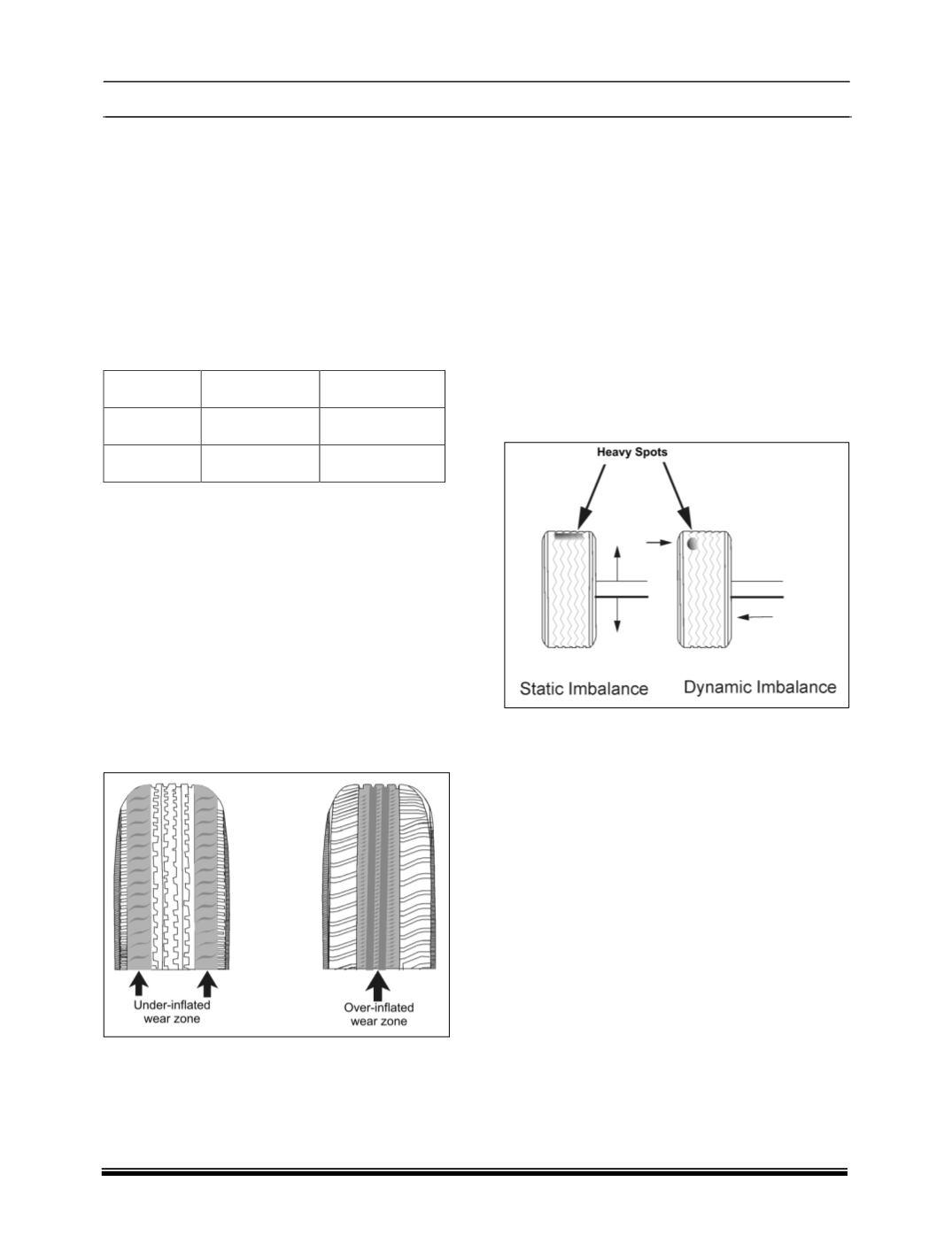
Under inflation or overloading creates
excessive deflection and hence heat, which
can lead to faster tyre wear and premature
failures. This could result in vehicle instability
causing damage to property, serious injury or
death.
Proper inflation optimizes tyre life and saves
fuel also.
II. WHEEL BALANCING
A balanced tyre is one where mass of the tyre,
when mounted on its wheel and the vehicle’s axle
is uniformly distributed around the axle
(its center
of rotation).
TYPES OF IMBALANCE
(a) Static Imbalance:
Vertical movement
resulting from heavy or light spots in a tyre in
such cases tyre won't roll evenly and the
tyre/wheel assembly undergoes an up-and-
down movement.
(b) Dynamic Imbalance:
Lateral movement
(wobble or shimmy)
resulting from unequal
weight on both sides of the tyre and wheel/rim
assembly’s circumferential centerline
The wheel should always be balanced and
aligned in order to provide:
(a) Enhanced tyre life.
(b) Driving safety and steering control
(c) Better performance of the vehicle.
Unbalanced tyre may lead to premature tyre wear
and driver fatigue due to vibration.
Tyres should always be balanced when:
(a) They are mounted on wheels for the first time
(b) When they are remounted after repair or
(c) When there are signs of shimmy or vibrations.
A vehicle is said to be properly aligned when all
suspension and steering components are sound
and when tyre and wheel assemblies are running
straight and true. Proper alignment is necessary
for even tread wear and precise steering. Uneven
front or rear tyre wear can lead to misalignment.
Following precautions should be taken while
balancing wheel: