




 433 / 1232

ENGINE 1.3L QUADRAJET (90PS)
96
Q
less air is introduced;
Q
the combustion temperature is reduced (on account
of the presence of inert gases) resulting in a
decrease in the formation of NOx (nitrogen oxides).
The injection control unit is constantly informed of the
quantity of gas recirculated through the information
coming from the flow meter: in effect, if there is an
intake of a certain quantity of air (Qam) for a given
engine speed and the value sent by the flow meter
(Qar) is lower, then the difference (Qgr) is the value for
the quantity of gas recirculated
Qam - Qar = Qgr
Qam - Theoretical quantity of air memorized
Qar - Actual quantity of air
Qgr - Quantity of recirculated gas
The atmospheric pressure signal is used for the
operation of the E.G.R. solenoid valve to recognize
the condition of driving at altitude in order to reduce
the quantity of gas recirculated and to prevent engine
fumes.
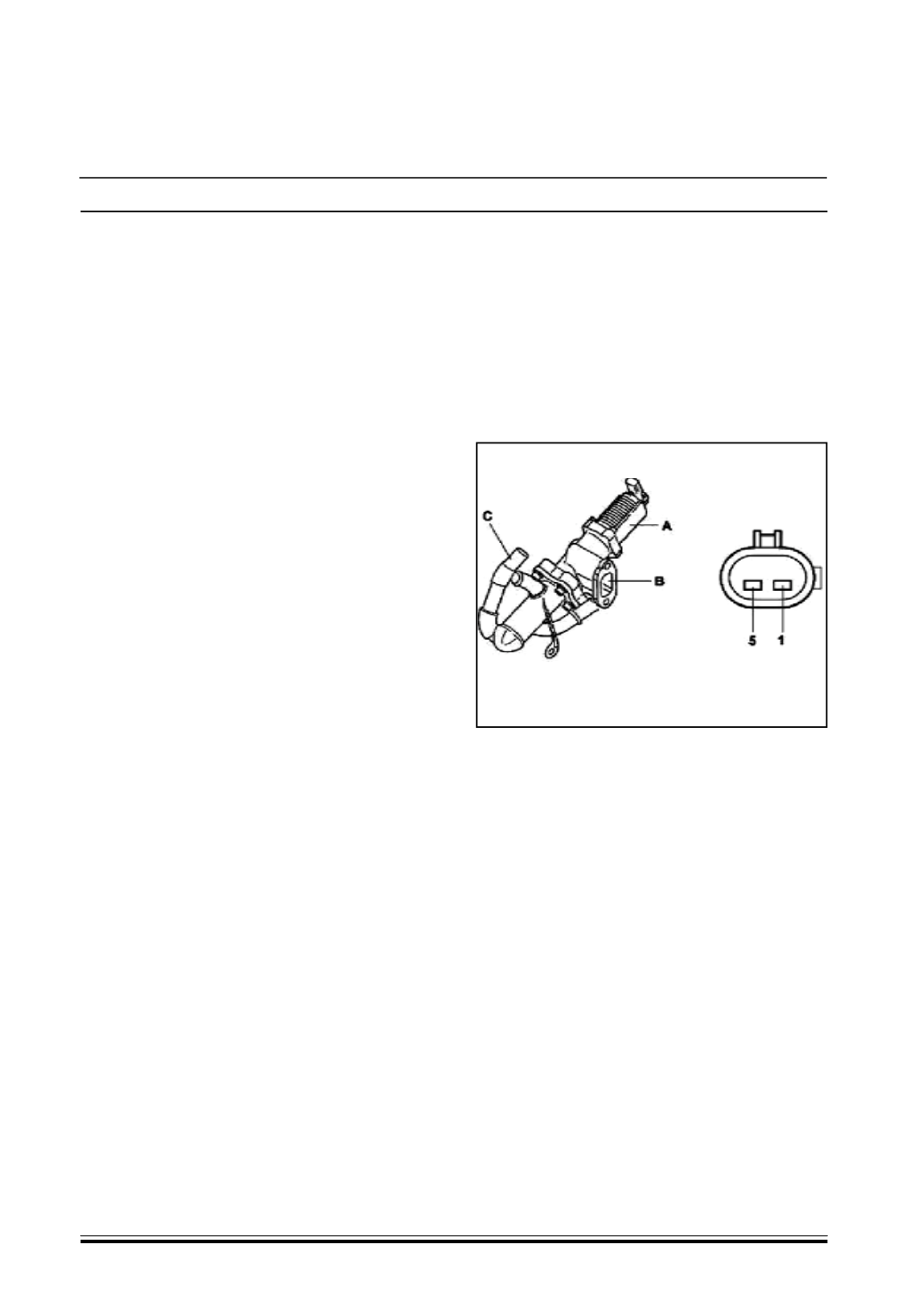
A - E.G.R. valve casing
B- Gas intake from exhaust manifold
C - Gas outlet to intake manifold
1 - Solenoid positive, 5 - Solenoid negative
D. E.G.R. SOLENOID VALVE
The Pierburg E.G.R. solenoid valve, fitted on the
cylinder head, has the task of modulating the flow of
exhaust gases to the intake according to the
command from the injection control unit.
This modulation takes place by means of the internal
solenoid, with PWM operation by the control unit,
which activates the control rod via the internal valve
which, once open, directs the gases to the intake
manifold.