



 495 / 1236

WHEEL AND TYRES
58
5.3.2.3 WHEEL AND TYRE REPLACEMENT
A. PRECAUTIONS DURING TYRE
REPLACEMENT
Following precautions should be taken while
replacing tyres:
1. Whenever a tyre replacement is necessary, the
new tyre should be of original equipment type. It
should be of the same size, load range and
construction as those originally fitted on the
vehicle. Use of any other size or type may
affect ride, handling and vehicle ground
clearance and tyre clearance to the body
chassis. Also be sure that the wheel rim size
and diameter are the right for the tyre to be
mounted.
NOTE
It is recommended that new tyres be installed in
pairs on the same axle.
2. Rim bead seats should be cleaned with a wire
brush or coarse steel wool to remove lubricants,
old rubber and light rust.
3. An inflated tyre, even with low air pressure,
must never be worked with a hammer while
trying to correct an improper position of the
rings. In such a case, the tyre must be deflated
completely before the necessary correction can
be done.
4. Whenever a tyre is dismounted from wheel rim
it should be remounted such that the tyre and
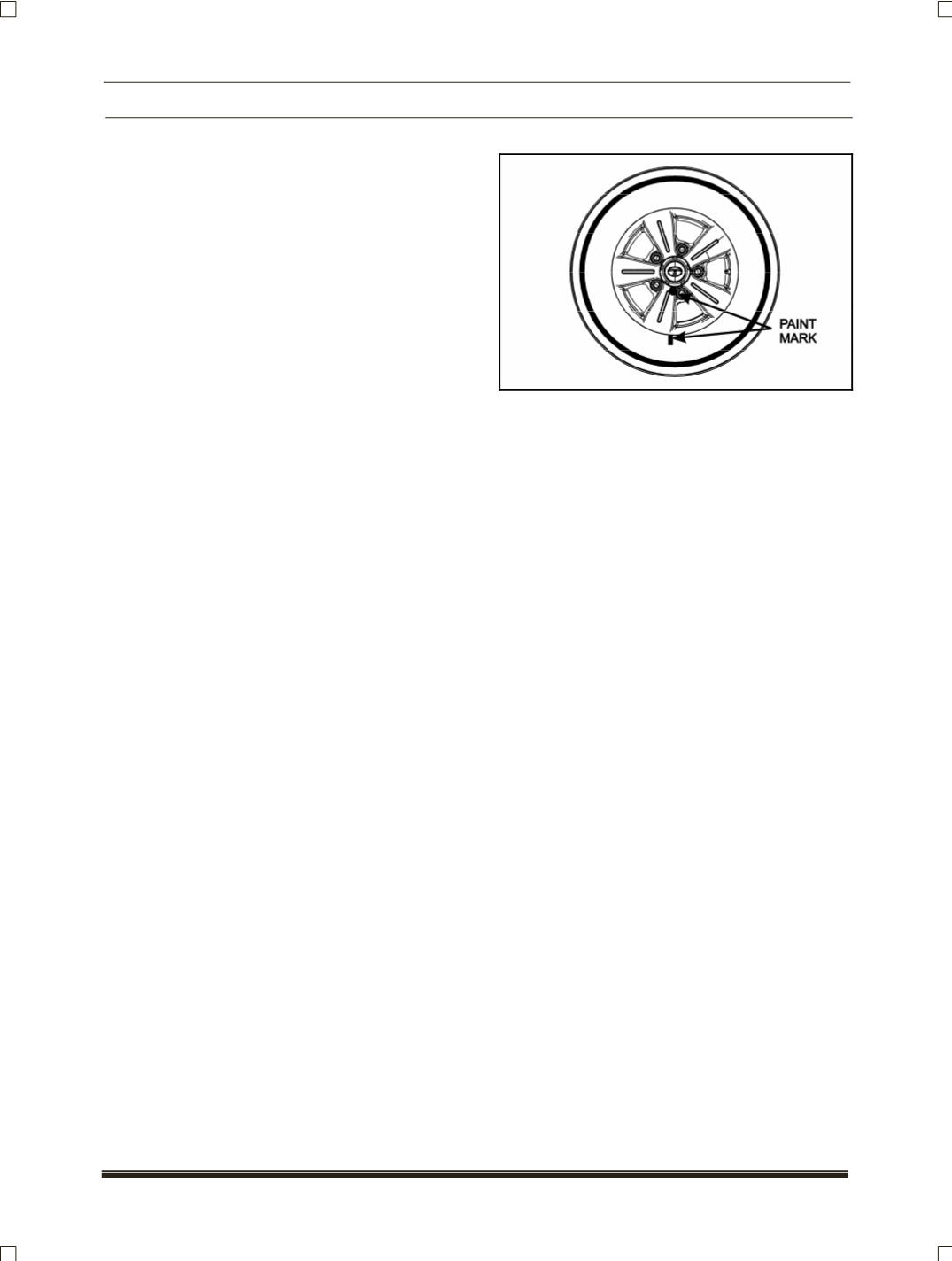
wheel rim are matched. If the tyre’s paint dot
cannot be located, a line should be marked on
the tyre and wheel rim before dismounting to
assure that it is remounted in the same position.
MATCHED TYRE AND WHEEL RIMS
Tyres and wheel rims are match mounted at the
assembly plant. This means that the radially stiffest
part of the tyre or “high spot” marked in YELLOW
on tyre, is matched to the smallest radius or “low
spot” of the wheel rim. This is done to provide the
smoothest possible ride.
The colour spots on the tyres are originally marked
by paint dot on the out board sidewall.
The “low spot” is originally marked by paint dot on
the wheel rim-flange. If properly assembled, the
wheel rim’s paint dot should be aligned with the
tyre’s paint dot as shown in the
figure