



 956 / 1526

100
ENGINE2.2LDICOR
Variable Turbin Technology (VTT) uses a variable
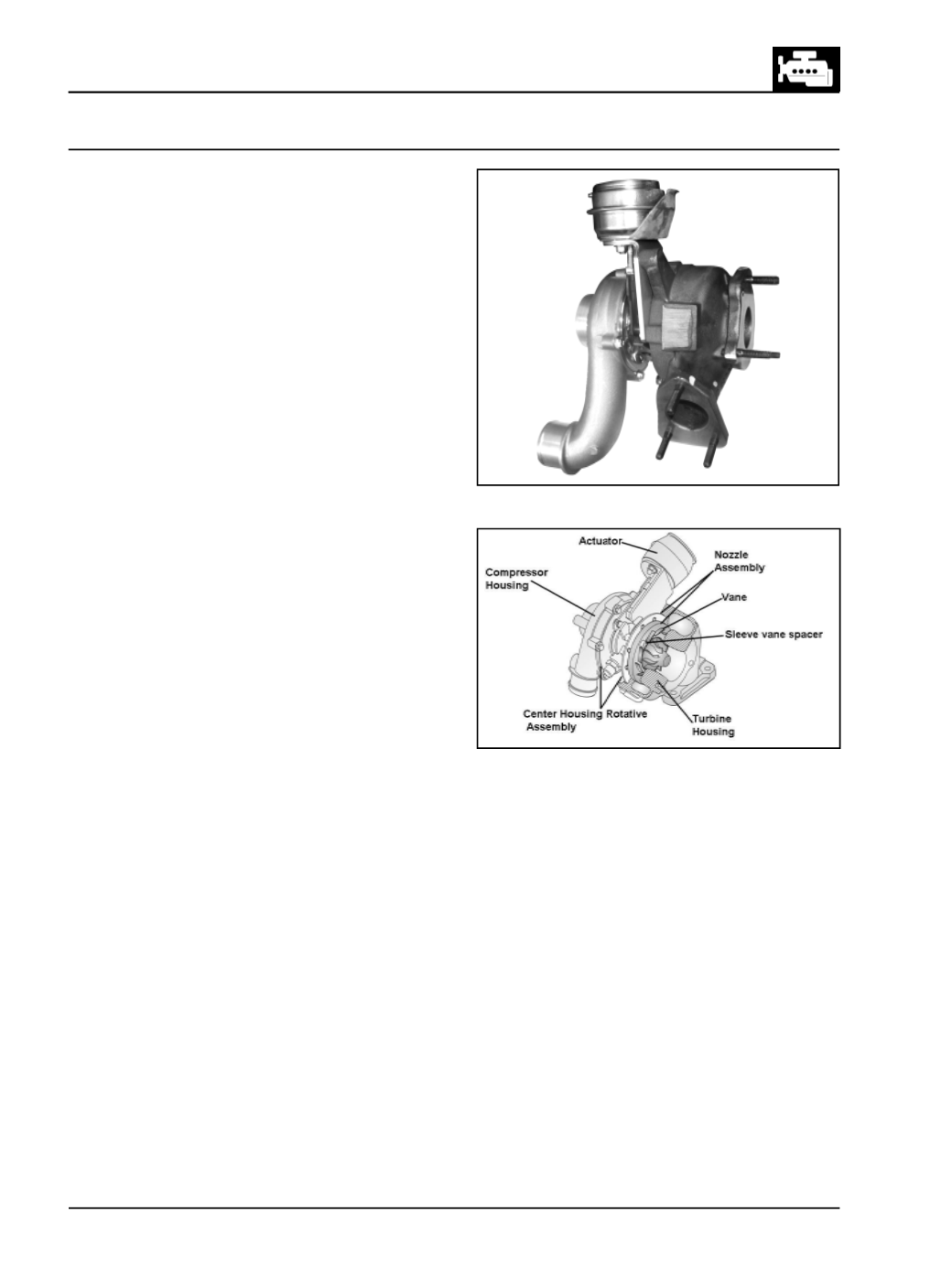
nozzle turbine (VNT) - Turbocharger
VariableNozzle Turbine Turbocharger
(Fig. 212)
Traditional turbochargers generate their maximum
boost pressure at high engine speed/load conditions.
At partial loads and at low engine speeds these
turbochargers generate limited boost. This in turn
limits the torque generated by the engine. Over-boost
is prevented with an exhaust bypass or "waste gate"
that limits the exhaust gas energy reaching the turbine
and this boost control is extremely limited.
This turbocharger enables exceptional flexibility in
matching and controlling engine air requirements over
extremely broad speed & load range by
accommodating variable exhaust flow rates.
This results in higher power and torque under all
operating conditions, resulting in excellent
acceleration & driveability under various speed & load
conditions
Higher Power
From low to high engine speeds, the turbocharger with
VTT delivers high a boost pressure with low pumping
losses resulting in higher power throughout engine
speeds.
Higher Torque and ImprovedTransient Response
At low engine speeds, the VTT turbocharger
accelerates more quickly due to lower inertia &
variable multi turbine vanes. This helps in increasing
the available high torque immediately after pressing
the accelerator pedal resulting in very good transient
response.
Lower Fuel ConsumptionandEmissions
A lower engine outlet pressure directly reduces fuel
consumption by reducing engine pumping losses.
Optimized boost pressure control by the engine
management system further improves fuel economy
and reduces emissions throughout the operating
range of the engine.
Construction and Function
The VNT Turbocharger has a set of movable vanes in
the turbine housing, and they control boost. At low
engine speeds when exhaust flow is low, the vanes
are partially closed. This increases the pressure of the
exhaust pushing against the turbine blades, making
the turbine spin faster and generating more boost. As
engine speed increases, so does exhaust flow, so the
vanes are opened to reduce turbine pressure and hold
VariableNozzle TurbineTurbocharger (VNT)
Fig. 212
VNT cross sectional view