




 490 / 896

498
BRAKE SYSTEM
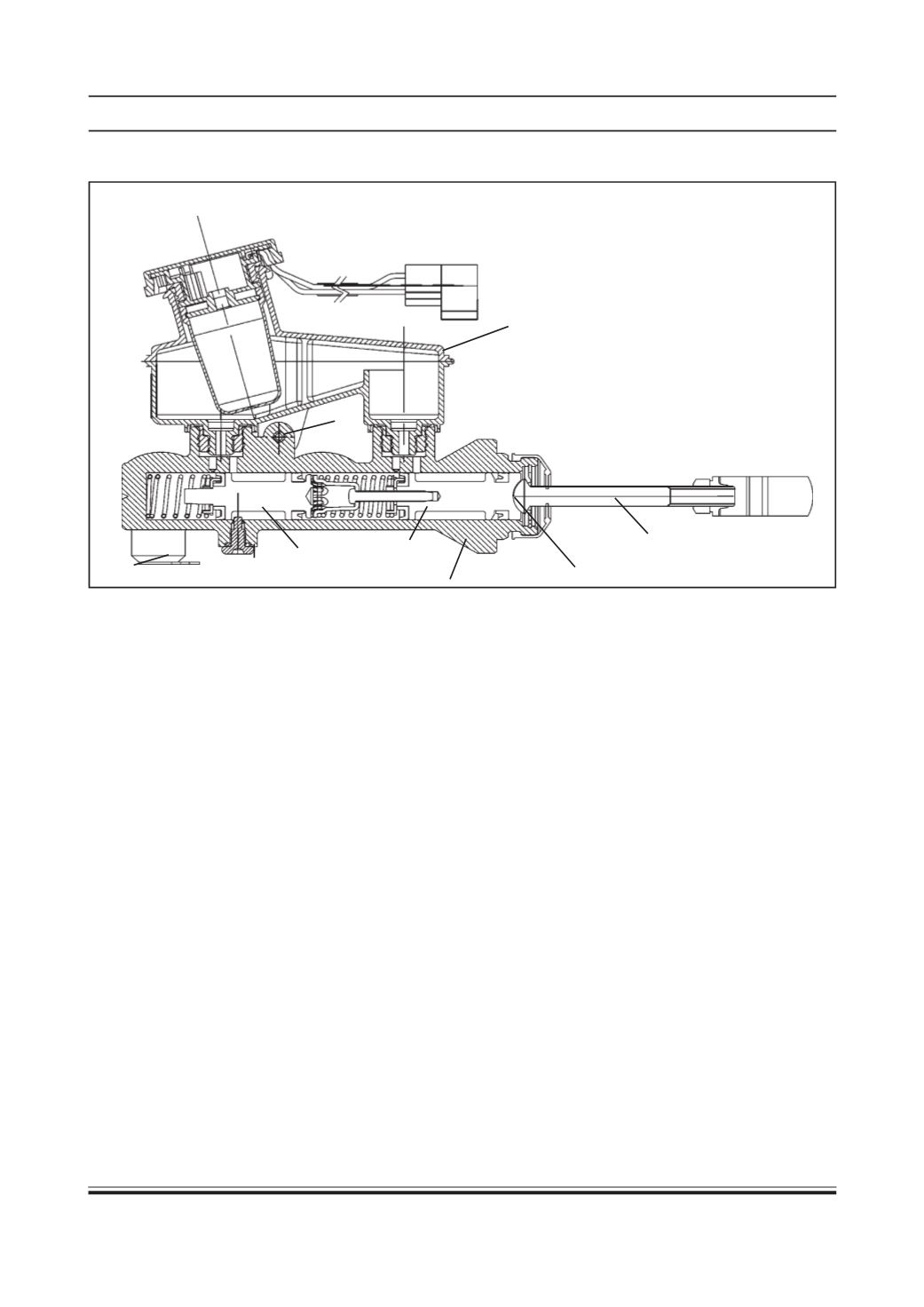
TANDEM MASTER CYLINDER (TMC)
General:
This is a light weight master cylinder with heat treated
Aluminum/Cast iron body and with bore anodized. It
has rigid steel pistons.
This Tandem Master Cylinder, is attached to the
transparent plastic brake fluid reservoir which is
inserted in to its inlet port, which has baffles to house
float of level indicator switch which shows the low
fluid level of reservoir and vertical baffles are
provided in order to divide the brake fluid of the
reservoir in two portions, one is for primary circuit,
the other one for secondary circuit. These baffles keep
bare minimum fluid on one circuit even if other circuit
is drained out. Fluid is circulated separately to
primary port and secondary port of TMC due to this
division.
TandemMaster Cylinder consists of two pistons, four
seals, two springs and spring seats. Out of which two
seals are fitted on secondary piston and two seals
are fitted on primary piston inside TMC bore.
Normal Operation:
Depression of the brake pedal forces primary piston
inside the bore, which in turn pressurizes the brake
fluid next to it and actuates brakes connected to
primary circuit. Simultaneously secondary circuit gets
operated and actuates another set of brakes.
One Circuit Operation Primary Failure:
Depression of the brake pedal makes primary piston
to move inside the bore, but due to failure of primary
circuit system can not hold the pressure, also brake
fluid next to it will not get pressurized. Still primary
piston keeps on moving finally compressing primary
piston return spring. When the primary piston return
is fully compressed the secondary piston moves and
pressurizes brakes connected to secondary circuit.
One Circuit Operation Secondary Failure:
In this case, the inward movement of the primary
piston has little effect in pressurizing the brake fluid
in the primary circuit initially, because the initial built
up of pressure in the primary circuit causes the
secondary piston to promptly yield and move inward
without much resistance as the secondary has a leak.
Very soon the secondary piston touches the cylinder
wall and hence stops moving forward. From this point
onwards, the pressure starts building up in the
primary circuit which actuates one set of brakes.
1 TMC casting
2 Primary piston assembly
3 Secondary piston assembly
4 Secondary piston stopper
5 Push rod assembly
6 Piston stopper complete
7 Brake oil reservoir
8 Closure plug
9 Spring pin
1
4
5
6
7
8
9
2
3