




 596 / 654

HVAC
839
HVAC
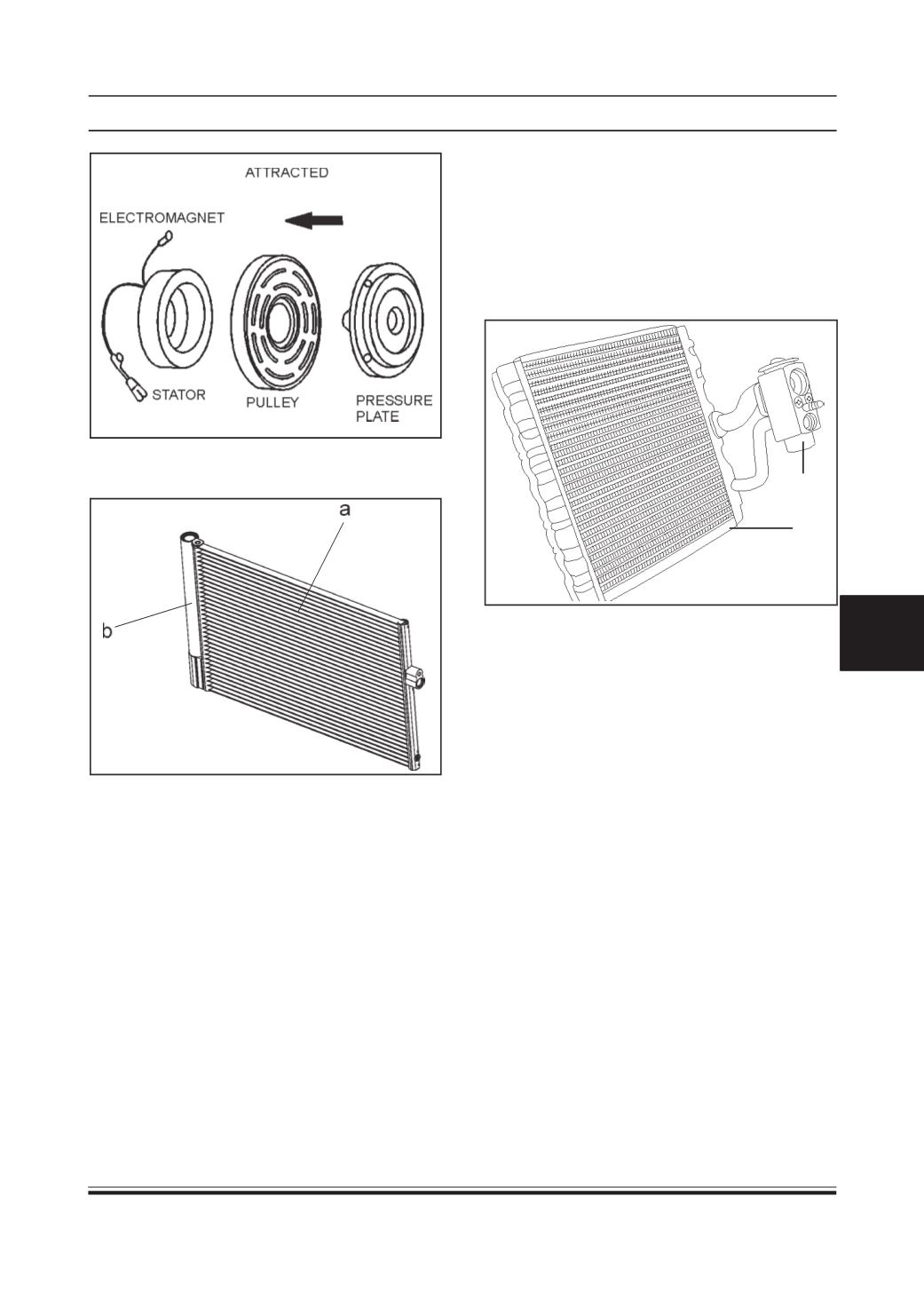
(a) Condenser:
It is the heat exchanger where heat dissipation takes
place. It consists of aluminium tubes and series of
fins to provide the maximum heat transfer. Air flow
across the condenser is induced by vehicle movement
and assisted by electric fan attached to the frame of
the condenser. The high pressure refrigerant vapour
enters the condenser inlet. As the vapour passes
through the condenser tubes, the air flow, assisted by
the fan, carries the latent heat away from the
condenser. This induces a change of state resulting
in the refrigerant condensing into a high pressure warm
liquid. From the condenser, the refrigerant continues
to the receiver/ dryer.
(b) Integrated Receiver Dryer (IRD):
This component acts as a reservoir and is used to
hold extra refrigerant until it is needed by the
(a) Evaporator unit
It is the last component in the cycle and serves as
heat absorption unit. As the refrigerant flows through
the evaporator it picks up heat from the cabin and
gets vaporized. As this change of state occurs, a large
amount of latent heat is absorbed. The evaporator is
therefore cooled and as a result heat is extracted from
the air flowing across the evaporator. The refrigerant
leaves the evaporator, on its way to the compressor,
as a low pressure gas. An evaporator sensor
(thermistor) measures the air temperature at the
evaporator outlet and sends signal to engine ECU for
engaging/disengaging of compressor to prevent icing
of the evaporator.
(b) Expansion valve
This small valve controls the flow of refrigerant into the
evaporator. It is controlled by a temperature sensor at
the evaporator outlet. If the outlet temperature is too
high, it means not enough refrigerant is flowing into
the evaporator and poor passenger cooling will result.
If the outlet temperature is too cool, it means too much
refrigerant is flowing and the evaporator fins will
probably load up with ice. In either case, the feedback
temperature sensor opens or closes the expansion
valve opening to achieve the correct flow rate and
evaporator outlet temperature.
Condenser and Receiver Dryer (R.D.)
evaporator. The drier within the receiver unit contains
a filter and desiccant (drying material) which absorb
moisture and prevent desiccant dust from being
carried with the refrigerant into the system.
The receiver drier is integrated into the condenser and
is seperately serviceable.
Evaporator unit and Expansion valve
a
b